
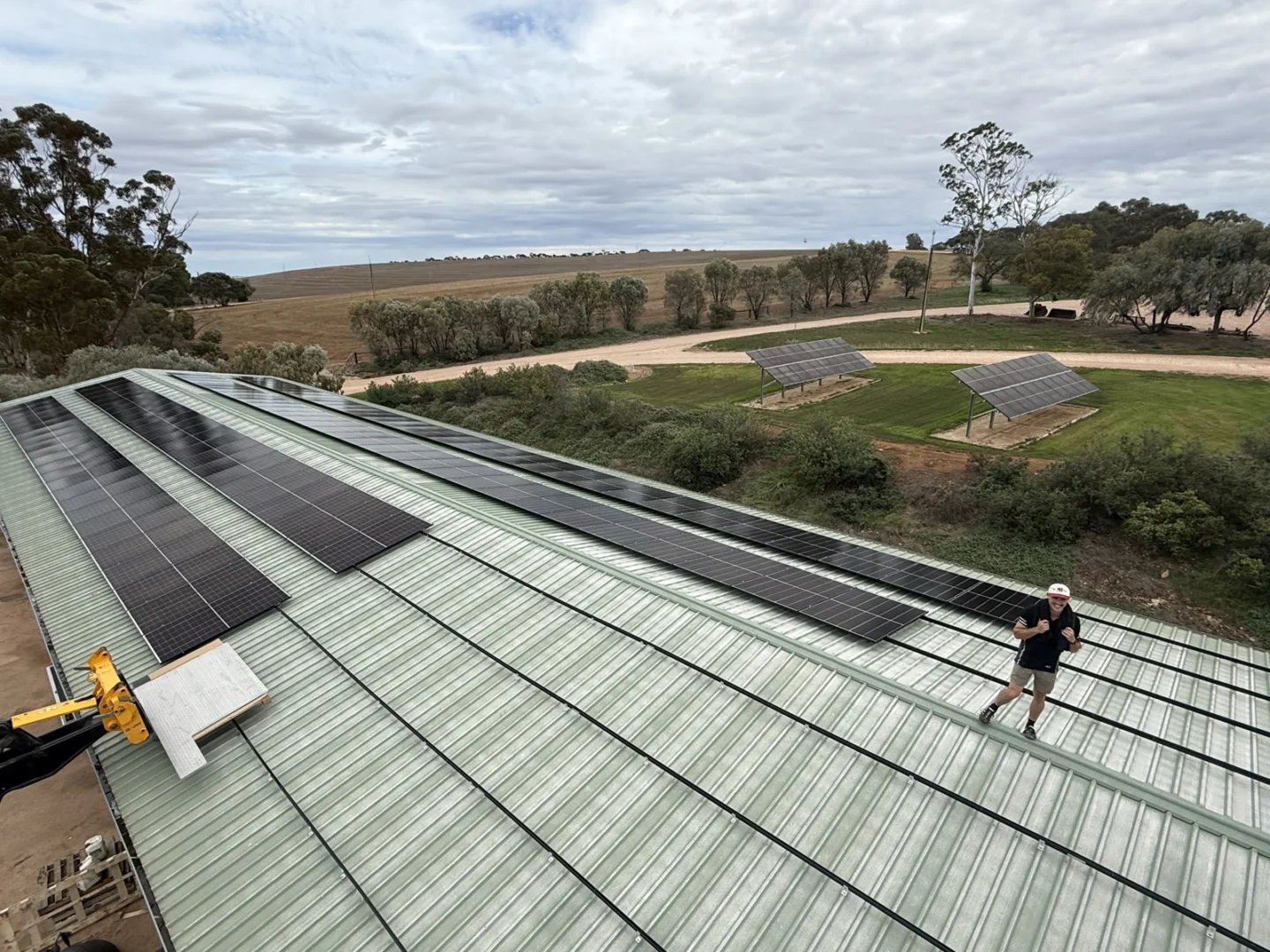
Off-Grid Battery Systems
Off-grid battery systems designed from the loads on your property, not sold as a kit. Battery bank, inverter-charger and generator control, installed by our own licensed electricians in South Australia and Queensland.
 4.9 Google 530+ reviews
 4.8 SolarQuotes
An off-grid battery system has to get the property through the worst week of winter
On a grid-connected home, a battery that's a bit too small costs you a few dollars a day. Off the grid, it means the generator running every night in July, or the lights going out. The battery bank is the part of an off-grid system that decides how the place lives: how much you can run after dark, how many grey days you can ride out, and how often the generator starts.
Deionno Electrical & Solar has built off-grid systems across South Australia, from the Adelaide Hills to the Barossa and beyond, and we take off-grid work in Queensland from our Sunshine Coast base. The design is led by our in-house off-grid specialist, who certifies this kind of work all over Australia, and our own licensed electricians do the installation. For the whole-system story, panels and all, see the off-grid solar page.
Already off the grid with tired batteries?
Tell us the inverter brand, the size of the bank and how often the generator runs. Our off-grid specialist can usually tell you on the phone whether the batteries can be replaced without starting again.
Who an off-grid battery system suits
Four properties we design battery banks for.
Swipe to see more
How big an off-grid battery bank needs to be
Start with what the property uses in a day, in kilowatt hours, on a normal day in the hardest month. The yearly average hides winter, and off-grid systems are sized for winter, because that’s when the days are short, the panels make the least, and the house uses the most.
Then decide how long the batteries should carry the place with nothing coming in from the roof. If the home uses 20 kWh a day and you want a day and a half of cover, that’s 30 kWh of battery you can actually use.
“Actually use” is the catch. Batteries are sold by their nominal size, and no battery gives you all of it. A lithium battery gives you most of its nameplate. An old-style lead-acid bank is normally run to about half, so a bank labelled 40 kWh behaves like 20. When you compare quotes, compare usable kilowatt hours.
We get the daily figure from what’s actually on the property: an audit of every load and how long it runs, plus generator hours and fuel use if there’s an existing system. That’s the difference between a system designed for your place and a kit off a shelf.
Days of autonomy and the generator trade-off
“Days of autonomy” is the design term for how long the bank runs the property with no solar and no generator. You choose it, and it trades off against the generator.
- A smaller bank and a generator that starts itself. One to two days of cover. In a long grey spell the generator tops the batteries up for a few hours and shuts down again. Lower cost up front, some fuel each winter.
- A bigger bank and a generator you rarely hear. Three days or more. Higher cost up front, very little fuel.
Battery capacity big enough to cover the worst week of the year sits unused for the other fifty-one, which is why a generator that starts itself earns its place on many of the systems we build. We show you both options with the numbers, and you choose.
Lithium or lead-acid batteries for off-grid
For twenty years off-grid meant a shed full of lead-acid cells. They worked, and they asked a lot: regular maintenance, careful charging, room to breathe, and a rule that you never took them below about half.
Every new off-grid battery bank we build is lithium, specifically lithium iron phosphate. It gives you most of its capacity instead of half. It charges faster, which matters when the sun is only out for four hours. It doesn’t need watering or an equalising charge, and it tells you its exact state of charge instead of leaving you to guess from a voltage.
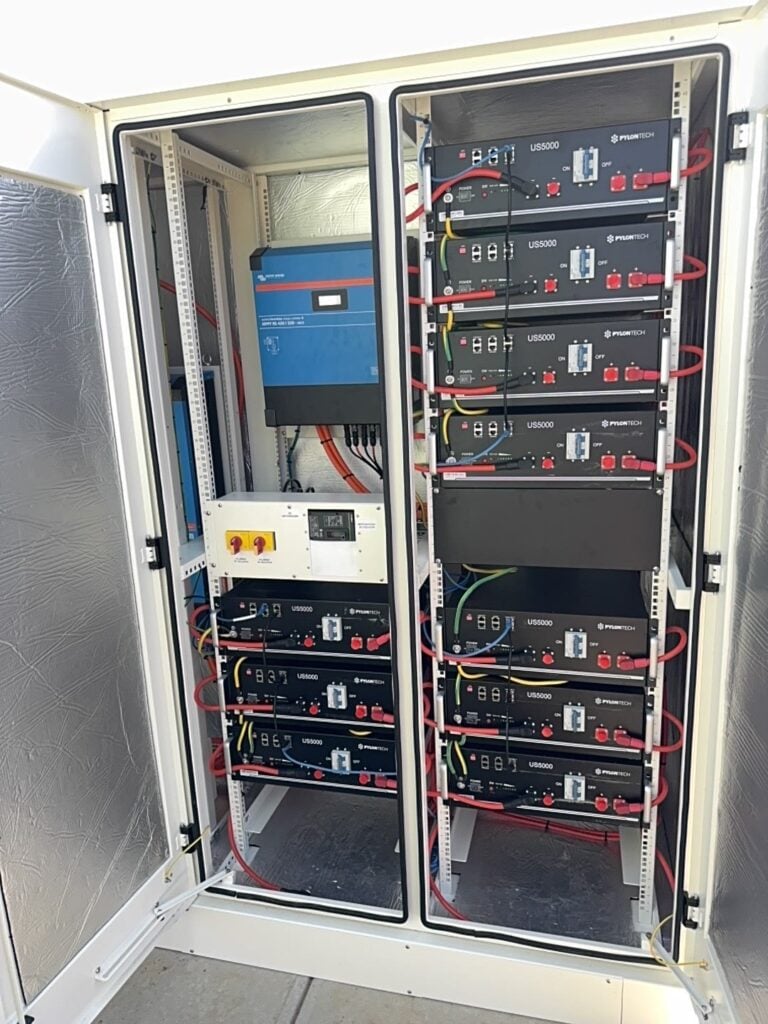
The lithium we’ve installed off-grid includes Pylontech modules behind Victron inverter-chargers, Sungrow battery towers and Sigenergy stacks. Which one suits depends on the inverter, so we choose the two together.
Replacing an old lead-acid battery bank
If you already live off-grid and the bank is at the end of its life, you usually don’t have to start again. What we check:
- The inverter-charger. Whether it can be set up for lithium and talk to the new battery’s management system. Many can. Some older units can’t, and then the inverter is part of the job.
- The solar charge controllers. Their settings have to change, because lithium charges differently from lead-acid.
- The cabling and protection. Lithium can deliver and accept far more current, so cable sizes, fuses and isolators are checked against the new bank.
- The room. A lithium bank takes a fraction of the space, and the rules for where it can sit are different.
Building on what is already there is normal off-grid work. At Dublin, north of Adelaide, we added panels and two more lithium modules to an existing Victron system and wired the generator to start itself, without replacing what was already working.
The inverter-charger: Victron, Sungrow and Sigenergy
Off the grid, the inverter does three jobs at once. It turns battery power into the 230 volts the house runs on. It charges the batteries from the generator. And it has to start every motor on the property with no grid behind it to lean on.
- Victron. Inverter-chargers built for stand-alone power from the ground up, with a dedicated generator input. Half of the off-grid systems on this website run on Victron, from 8 to 15 kVA, with Pylontech batteries.
- Sungrow. Hybrid inverters with Sungrow’s own battery towers. We’ve used them off-grid from a 5 kW single-phase home to a 25 kW three-phase system with 40 kWh at Mount Pleasant.
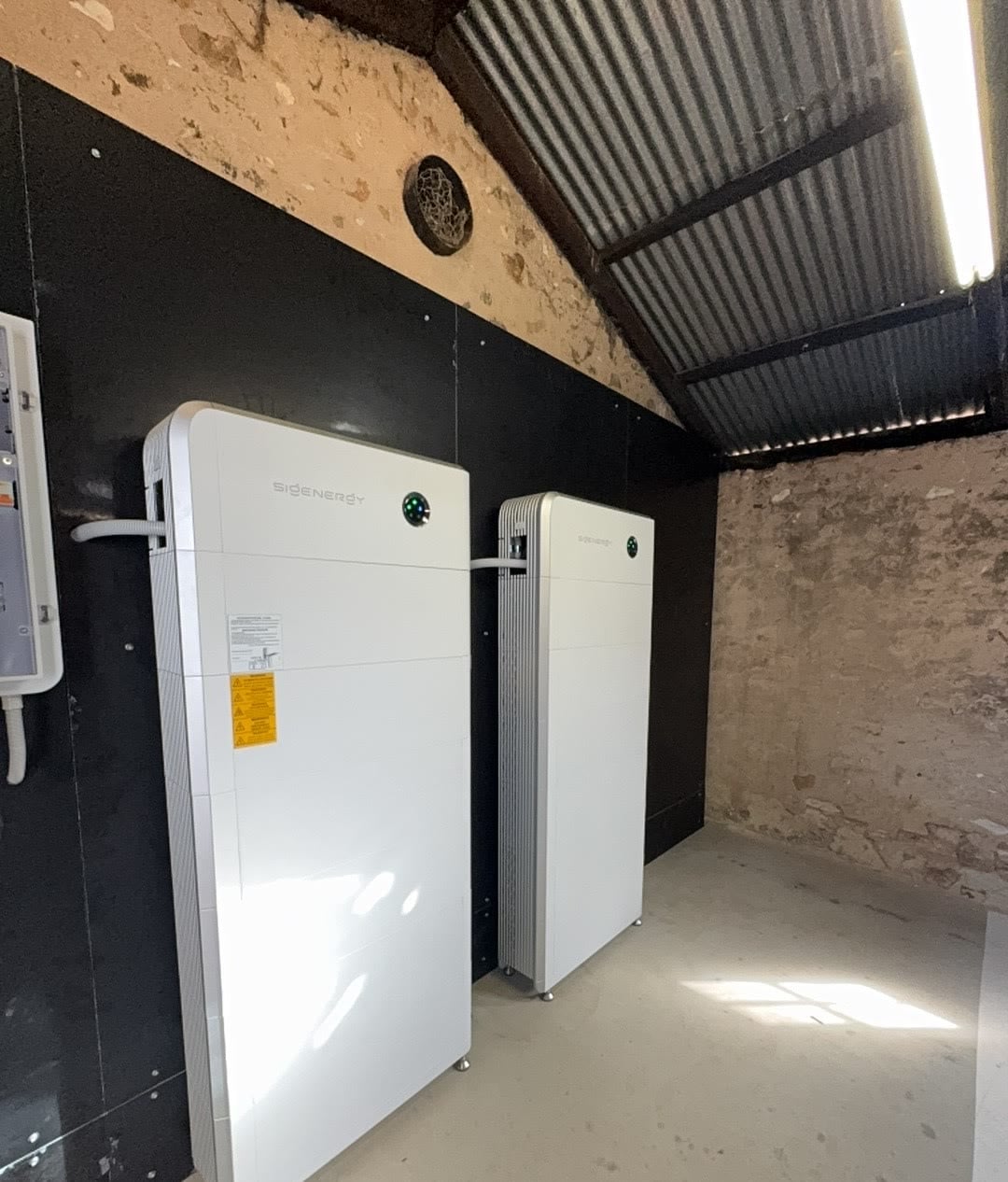
- Sigenergy. The inverter and battery modules in one stack. At Hart, two 30 kW three-phase Sigenergy inverters and twelve battery modules run a property with 93.6 kWh of storage.
The hard part is always motors. A bore pump or a compressor can ask for several times its running power in the second it starts. On the grid nobody notices. Off the grid the inverter has to supply it, so we size the inverter to the biggest thing that has to start.
Generator auto-start and what triggers it
A generator on an off-grid system should not need you. The inverter or its controller watches the battery, and when the charge falls to a level we set, it closes a pair of contacts, the generator starts, and it runs until the bank is back up to a second level. Then it stops.
We set the trigger points with you: low enough that the generator isn’t starting on every cloudy afternoon, high enough that the batteries are never run flat. The generator has to be an auto-start model with a two-wire start input, and it has to be sized to charge the batteries and run the house at the same time. Eight of the off-grid systems on this website have a generator wired in, most of them diesel.
Can a Powerwall or home battery run off-grid?
The batteries sold for suburban homes are designed first for a house with a grid connection: store the solar, cover the evening, back the house up in a blackout. Running a property with no grid at all, every day, with a generator in the mix, is a different job.
We’re a Tesla Powerwall certified installer and we do install Powerwall 3. For a property with no grid, it isn’t what we reach for first. We prefer the equipment above, Victron, Sungrow and Sigenergy, because it’s what we’ve built our stand-alone systems with, generators and big motor loads included. If you have a Powerwall in mind, talk to us and we’ll tell you whether it suits your site.
Where an off-grid battery bank goes
The same Australian standard that governs suburban batteries applies off-grid. The bank stays out of bedrooms and living areas, away from exits, and on or against something that will not burn.
On a rural property that usually means one of three places: a lined bay in a shed, a purpose-built outdoor cabinet on a concrete pad, or a plant room on the side of the house. At Macclesfield the whole system, inverter-charger and batteries, lives in a weatherproof cabinet beside the tanks, with the generator next to it. Short cable runs between the batteries, the inverter and the generator matter more off-grid than anywhere, so we place the three together.
The battery rebate on an off-grid system
The federal battery rebate does apply off-grid, with conditions set by the Clean Energy Regulator [1].
- The battery has to serve a home that is lived in. A system that only runs a shed or a bore pump does not qualify.
- It has to be installed with solar, new or existing.
- If the property is more than a kilometre from the grid, the battery does not need to be able to join a virtual power plant. Closer than that, it does, unless the network confirms a connection would cost more than $30,000.
- The rebate is paid on the first 50 kWh of usable capacity, at a rate that falls with size.
We work out what applies to your property and take it off the quote. Our battery rebate calculator gives a starting figure.
Off-grid battery systems we have installed
The eighteen off-grid systems on this website are all in South Australia: Macclesfield, Kalbeeba, Tungkillo, Concordia, Dublin, Taunton, Mount Magnificent, Mount Pleasant, Palmer, Barossa Goldfields, Hindmarsh Valley and Hart among them. The battery banks run from 12 kWh up to 93.6 kWh at Hart.
South Australia
We cover the Adelaide Hills, the Fleurieu, the Barossa and Murray Bridge from Salisbury Plain, and travel further for off-grid work. See the Adelaide battery installation page.
Queensland
We take off-grid work across the Sunshine Coast hinterland, Noosa and Gympie from our Corbould Park base. The design comes from the same off-grid specialist and the installation from our own Queensland electricians. See the Sunshine Coast battery installation page.
Sources
- Clean Energy Regulator, Solar batteries, updated 29 October 2026.
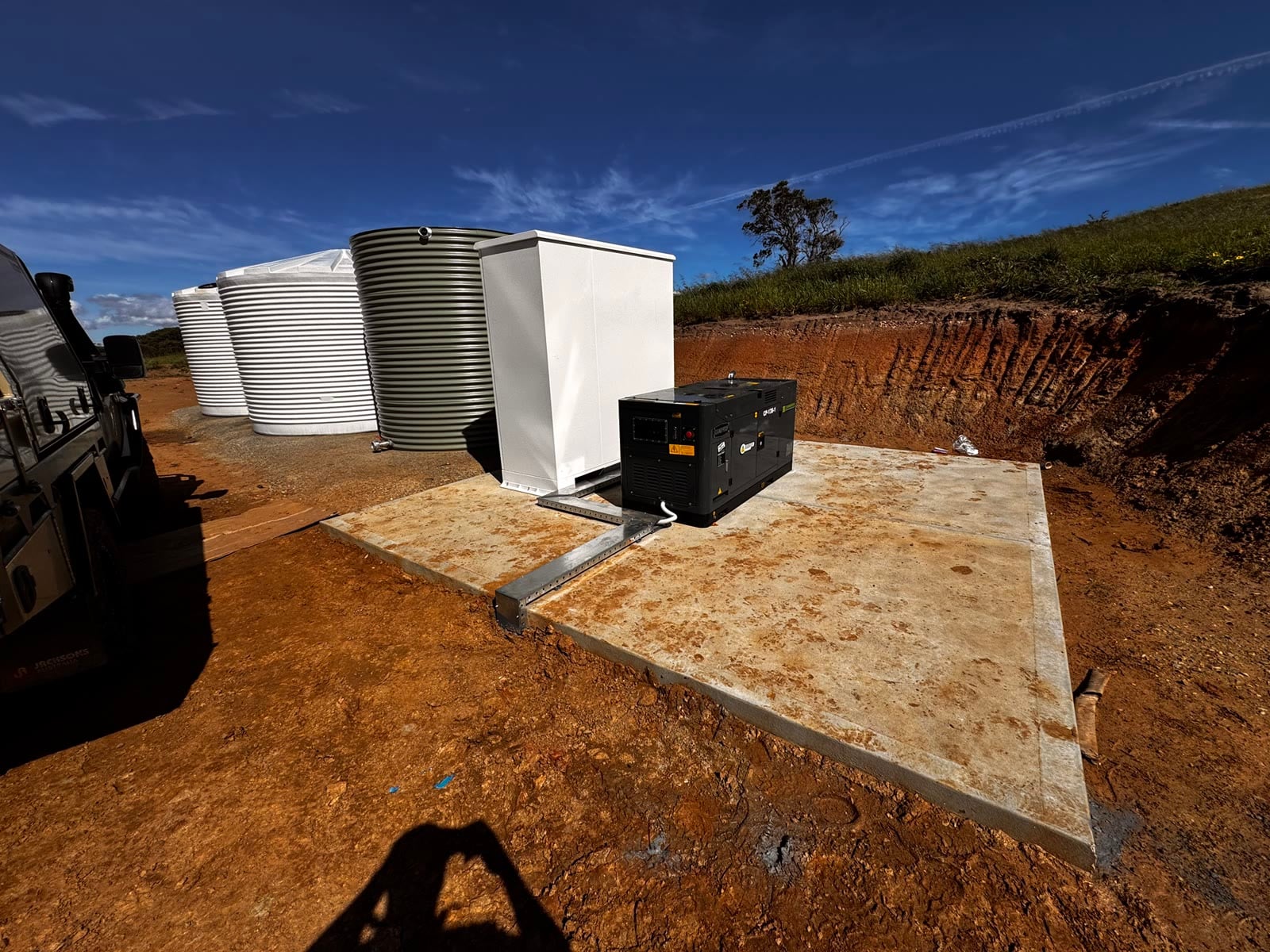
Off-Grid Solar and Battery System in Macclesfield, SA
A 13.2 kW off-grid solar system with a Victron 15 kVA inverter charger, 28.8 kWh of Pylontech batteries and generator auto start, in an outdoor power cabinet.
Outcome: A home running on its own power, with 28.8 kWh of lithium and a generator that looks after itself.
Read the full projectHow an off-grid battery system comes together
From the load audit to the first night on the batteries.
Swipe to see more
Off-grid battery questions, answered
Straight answers from our electricians. Can’t find yours? Call 1800 610 165 or book the assessment and ask on the day.
What size battery bank do I need to go off-grid?
Take what the property uses on a normal winter day, in kWh, and multiply by the days you want the batteries to carry it with no sun. A home using 20 kWh a day with a day and a half of cover needs about 30 kWh of usable battery. We measure the daily figure with a load audit on site.
How many days of battery storage should an off-grid system have?
With a generator that starts itself, one to two days is common and keeps the cost down. Without one, or where you never want to hear it, three days or more. It is a trade between battery cost and fuel, and we price both.
Is lithium or lead-acid better for off-grid?
Lithium. It gives you most of its rated capacity where lead-acid gives about half, charges faster on short winter days, and needs no watering or equalising. Every new off-grid bank we build is lithium iron phosphate.
Can I replace my old lead-acid batteries with lithium?
Usually, yes. We check that the inverter-charger can run lithium, change the charge controller settings, and check the cabling and protection against the new bank. If the inverter is too old to work with lithium, it becomes part of the job.
Do I still need a generator with an off-grid battery system?
Nearly every off-grid property is better with one. It covers the long grey spells so the battery bank doesn’t have to be sized for the worst week of the year. We wire it to start and stop itself from the battery’s state of charge.
Can a Tesla Powerwall run off-grid?
We install Powerwall 3. For a property with no grid we prefer Victron, Sungrow or Sigenergy, because they’re what we’ve built our stand-alone systems with. Talk to us about your site before you decide.
Does the battery rebate apply to off-grid systems?
Yes, where the battery serves a home that is lived in and is installed with solar. A system that only runs a shed or a bore pump doesn’t qualify. The rules differ for properties within a kilometre of the grid. We work it out for your property.
Where does an off-grid battery bank go?
In a lined bay in a shed, an outdoor cabinet on a concrete pad, or a plant room, close to the inverter and the generator. It can’t go in a bedroom or living area and has to sit on or against something that will not burn.
Do you install off-grid systems in Queensland?
Yes. We take off-grid work across the Sunshine Coast hinterland, Noosa and Gympie. The systems shown on this page are in South Australia, where our off-grid work began, and the same specialist designs the Queensland ones.
How much does an off-grid battery system cost?
It depends on the usable battery size, the inverter, whether a generator is being supplied or connected, and where the equipment is housed. There’s no honest kit price. We quote in writing after a free site visit and a load audit, with the options side by side.
Keep reading
Work out your numbers first
One thing to look at before anyone comes out.
See a real proposal
A sample of the written proposal you get after the assessment: gear, cost, output, savings and timeline.
View the sample proposal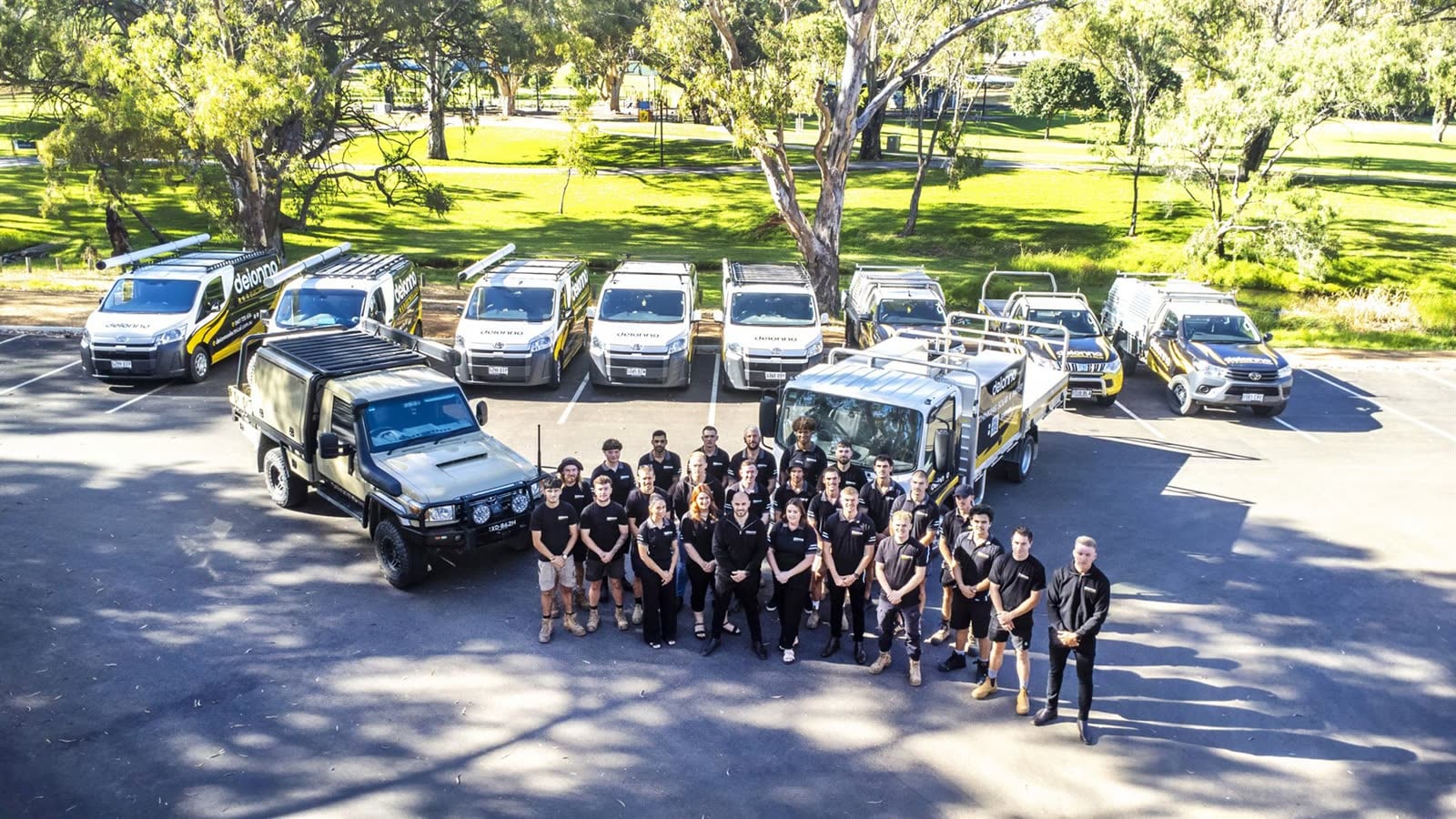
Ready to start?
Book a free 60-minute on-site assessment with one of our licensed electricians.
Free 60-minute on-site solar and battery assessment. No obligation.

$0 power bill guarantee
Arrange your free 60 minute on-site Solar & Battery Assessment in 30 seconds!
Which state is your home in?
Do you own your home?
Unfortunately, we only work with homeowners
If you are considering solar for a new home, or on behalf of someone else, select "I own my home"
We only work with homeowners
A solar or battery system is a permanent change to the property, so it needs to be arranged by the person who owns the home.
If you tapped that by mistake, head back and we'll pick up where you left off.
What are you looking for?
Our team can talk you through all options if you're not sure.
What appeals to you most?
You'll get all of these. We'd just like to know what matters most.
How much is your quarterly electricity bill?
The average Adelaide home spends $500 - $1000 per quarter. Not sure of yours? Take your best guess, we'll go through the real numbers at your assessment.
Whatever it is today, our goal is $0. If we don't get you there, we'll pay your bill.
How soon are you looking to get a system installed?
We can work with you on a longer timeline, or get you saving as soon as possible.
What is your address?
We have hundreds of happy customers across South Australia. We need your address to check we service your area and to look at your roof before we visit.
Great news, we service your area!
Anything else to share?
Every system we design is tailored to the home, so the more info the better! (Optional)
How should we get in touch with you?
Last step. We'll call to arrange your free on-site assessment at a time that suits you. No pressure and no obligation.
Request sent, we'll be in touch!
Do you want to skip the queue?
Call to speak directly with a solar specialist during business hours, and we can get your free on-site assessment booked in straight away.
📞What happens next?
- 1We'll give you a call
If you haven't called already, we'll give you a call to say hello.
- 2Discuss your needs and goals
We'll chat about what you're looking for, how we can help, and book in a time for your on-site assessment that suits you.
- 3Your free on-site assessment
We visit your home for 45 to 60 minutes to measure up the roof, check the switchboard and review how you use power.
- 4We send your detailed quote
A tailored proposal with the system design, the savings and the pricing laid out in full.
- 5We design and install
If you're happy with the proposal, our in-house team installs it and shows you how it all works.
4.9Google · 530+ reviews
4.8SolarQuotes reviews